Sang Ye's Hong Shau Rou (Braised Pork)
1kg streaky or marbled pork (use spare ribs if marbled pork is not available)
1/2 cup soy sauce
1 tablesp sugar
2-3 cloves garlic
5-6 slices ginger
2 stalks spring onions cut thinly
1 tablesp oil
2 tablesp cooking wine
an 'appropriate amount' of star anise
an 'appropriate amount' of cinnamon
an 'appropriate amount' of cumin
an 'appropriate amount' of brown peppercorn
an 'appropriate amount' of MSG
Dice the pork into 1.5cm cubes 'mahjong slices'.
Place the diced pork into a pot of boiling water for a few minutes. Drain and set the boiled pork aside. Reheat the pot, add a bit of oil, ginger and spring onions, garlic and stir. Place meat back in the pot and stir again. Add all the condiments, the soy sauce, wine, sugar, and 6 to 7 cups of water and bring the boil. Simmer for one hour or so. until most of the water has evaporated. If the meat is not yet tender, you might have to simmer for a while longer.

A collection of my food experiences: restaurants and recipes.
Wednesday, 27 January 2016

Chinese Cabbage with Ham and Cream Sauce
March 30, 2010
Chinese Cabbage with Ham and Cream Sauce
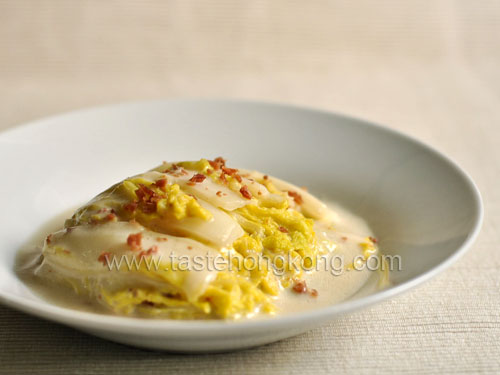
This is a popular dish of Beijing cuisine, which in Chinese is called 腿茸奶油津白.
When preparing this at home, I often apply my own preference. What I mean is to cook and flavor the cabbage predominately with ham and to coat it lightly with a creamy sauce which at the same time should not over-power the tastes of others. As such, I use no chicken stock, butter, and lard. Instead, I toast, stir-fry and then simmer the ham in the sauce to release its flavor. This might be a less oil-laden version however I find it equally flavorful.
This recipe needs only a basic technique of stir-frying vegetables. Having combined the cabbage with the ham, the seasoning and the sauce at the right time, I would say there is nothing complicated.
However, be honest, I also love to order this dish when dinning out. It is usually available at restaurants serving Beijing or Shanghai or even Sichuan cuisine, places like those I mentioned about their pork dumplings (Xia Long Bao小籠包).
- Ingredients
- 400g Chinese cabbage
- 100 ml fresh milk
- 2 tsp finely chopped ham (I use Jin Hwa ham bought from a specialty store. If not, use any dry-cured Chinese ham which can be found in vacuum packs in groceries and some supermarkets.)
- 1 tsp salt
- 7-8 slices of ginger
- 1 1/2 tbsp oil for stir frying
- Thickening
- 1 tsp plain flour
- 1 tbsp water
Method
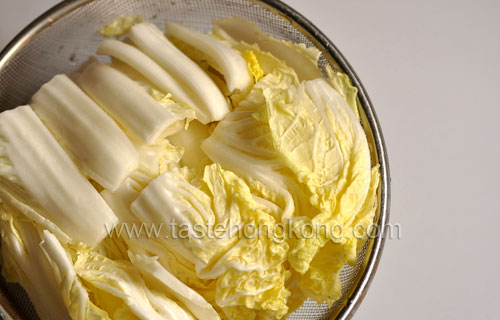
Rinse cabbage, cut it lengthwise into chunks of about 6 cm in length and 2 cm in width.
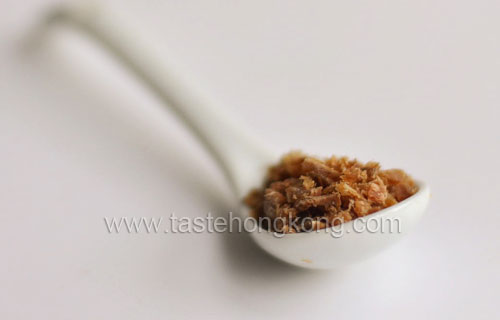
To prepare the ham, rinse, pat dry, and cut it into thin slices. Then heat them in a toaster under low heat for about 4 to 5 minutes or until fragrant. Let cool a while, finely chop them. The sliced ham is relatively easier to chop than it is just out from the fridge.
Heat wok over high heat. Add 1 table spoon of oil, distribute it halfway over the sides. As soon as the oil starts to smoke lightly, put in ginger slices. With a turner, briefly stir them in oil for a couple of seconds. In this step, from heating the wok to sautéing the ginger, actually is a Chinese way of cooking for stir-frying vegetables.
Pour in cabbage chunks. Keep stirring and flipping the vegetable. In about one minute, the cabbage shall be softened a bit and start to exude water. If not, add about 1 table spoon of water. Cover lid and turn to medium heat to simmer the cabbage for about a minute. Remove lid, add salt, give a few more flips and stirs to mix it well with the cabbage. As salt is added, more water will be exuded, so act fast for the stirring. Dish up, discard water and ginger.
Add the remaining half table spoon of oil in wok. Toss in half of the chopped ham, sauté it briefly, pour in fresh milk. Over low to medium heat, bring to a boil. Return the cooked cabbage to wok, simmer for about a minute. Stir well the thickening and mix it into the sauce. As soon as the cream boils up again and thickened, remove from heat (check the taste, as the saltiness from ham may vary). Dish up cabbage and sauce, garnish with remaining ham. Serve hot and enjoy.
Tuesday, 13 October 2015

Monday, 12 October 2015
Soft boiled eggs
Malaysians Style soft boiled eggs.

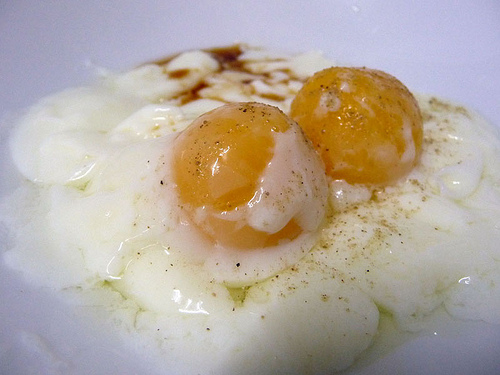
This is a real Malaysian breakfast: soft boiled eggs broken into a small bowl with white pepper and soy sauce and a kopitiam, a drink. The toast is a thick home made style bread toast with no crusts and a heavy slathering of margarine. The kaya toast if you feel like celebrating with something sweet is the same thick toast with a generous slathering of butter and a layer of kaya. The toast is then dipped in the egg and the remainder egg eaten with a teaspoon.
It must take great care and precision to produce a precisely soft boil egg for every order. They would have to use timer and a staff member whose job is to only to hang around these eggs. One day, I spotted a yellow tower at a cafe with no burners. It looked like something one would put in a microwave but it looked too tall to fit. I saw eggs in them once. I also saw the customers having our typical breakfast. I put two together and realised the yellow tower made those eggs, but I didn't understand how and specifically how this cafe with no kitchen could produce this.
I finally asked, they confirmed my suspicion, but I still didn't understand how that yellow tower produced soft boiled eggs. I stumbled across the device on the net and found it was this:

It is a soft boiled egg cooker invented by a Malaysian. Typical for a Malaysian invention made in his kitchen in a terrace house in the middle of Cheras. (I am imagining this) It is made with the cheapest materials to make the device most affordable. It is utterly simple in its design and lacks the strong 'designed by a marketing advertising executive' who would have loaded it with accessories and weight to deserve its place in the middle class kitchens of the world. What happened to simplicity?
The most important part of this device is the valve, the only piece of non plastic. This is his story as said in the Star newspaper.
This is a real Malaysian breakfast: soft boiled eggs broken into a small bowl with white pepper and soy sauce and a kopitiam, a drink. The toast is a thick home made style bread toast with no crusts and a heavy slathering of margarine. The kaya toast if you feel like celebrating with something sweet is the same thick toast with a generous slathering of butter and a layer of kaya. The toast is then dipped in the egg and the remainder egg eaten with a teaspoon.
It must take great care and precision to produce a precisely soft boil egg for every order. They would have to use timer and a staff member whose job is to only to hang around these eggs. One day, I spotted a yellow tower at a cafe with no burners. It looked like something one would put in a microwave but it looked too tall to fit. I saw eggs in them once. I also saw the customers having our typical breakfast. I put two together and realised the yellow tower made those eggs, but I didn't understand how and specifically how this cafe with no kitchen could produce this.
I finally asked, they confirmed my suspicion, but I still didn't understand how that yellow tower produced soft boiled eggs. I stumbled across the device on the net and found it was this:
It is a soft boiled egg cooker invented by a Malaysian. Typical for a Malaysian invention made in his kitchen in a terrace house in the middle of Cheras. (I am imagining this) It is made with the cheapest materials to make the device most affordable. It is utterly simple in its design and lacks the strong 'designed by a marketing advertising executive' who would have loaded it with accessories and weight to deserve its place in the middle class kitchens of the world. What happened to simplicity?
The most important part of this device is the valve, the only piece of non plastic. This is his story as said in the Star newspaper.
- How did it happen? Back in the days when Datuk Hew Ah Kow was just a lad working as a bulldozer operator in the jungles of Kelantan in 1973, there was little time to keep count of the minutes.thestar.com.my
“There were about 20 of us in a lumber camp who liked nothing better than to start the day with half-boiled eggs. The problem was, we always lost track of time, carried away with things like checking the engines and refuelling. So, by the time we got back to our eggs, they were always overcooked,” recalls Hew.
“Young and full of bravado, I took it as a challenge and began to conduct my own experiments, puncturing the bottoms of Ovaltine cans with a nail and filling them with eggs and hot water,” says Hew.
It took a year before Hew found the correct ratio of water to eggs. As he drew closer to a solution, Hew’s tests made him go off eggs. It also affected his colleagues who had to help eat his experiments. - The effort eventually paid off when one day, a direct-selling stockist rode his Honda Cub into Hew’s work camp and got marooned by the rain, forcing an overnight stay. At breakfast, he got to sample the most perfect half-boiled eggs he had ever tasted.
“It was the camp cook who pointed me out. At first, he came to me and asked if I could give him one of my Ovaltine cans to take home. I said ‘No way.’ Then he asked if I could sell him the prototype so I said, ‘Fine, let me see the money first.’ He returned and gave me RM7,000,” recalls Hew.
Saturday, 10 October 2015
Gula Melaka
http://eatingasia.typepad.com/eatingasia/2015/08/on-pursuing-an-obsession-and-getting-nowhere-until-you-do-me-and-palm-sugar-.html
Friday, 9 October 2015
Broad beans and Feta salad

My neighbour grows broad beans for the neighbour over her other side. She said it was his favourite and she grew it in exchange for all the favours he gives her. It made me think that broad beans must be something amazing.
In Japan, we were once served a burnt broad bean pod. All they did was burn the broad bean shell and all over a barbecue, sprinkled with salt and served on a long plate. We were meant to break into the blackened skin and eat the inside. The way it was presented, I thought I was eating the most wholesome, treasured broad bean.
So I have been dreaming about a good broad bean recipe, I buy broad beans and managed to get Nathan to like it raw.
Here is one that I made for my mother's birthday dinner. I cooked roast lamb with lots of roast vegetables - brinjal, tomatoes, zucchini, onions. and needed something green. This wasn't planned so this is what I did:
1 packet Frozen broad beans
1/4 cup Frozen small peas
1/4 packet of Feta cheese block
Sprinkle of dried oregano
Slice the Apple mint leaves finely
Sliced roasted pistachio nuts
Glug of olive oil and lemon juice
Chilli flakes, salt and pepper
Throw the packet of frozen broad beans into boiling water for 5 minutes.
Then remove, allowing it to cool, then remove the broad bean skin.
Heat the frozen peas for 1 minute.
Break up the feta with a fork till it is crumbly. Stir in the oregano to flavour it.
Leave this to marinade while removing the broad bean skin
Mix the broad bean, peas, and salt.
Add the lemon juice, feta and fold gently.
Spread the mint, pepper and chilli all over the top of the salad. Fold them in.
Sprinkle the sliced pistachios
Serve.
We could add:
Fried bacon bits
Apple bits
Subscribe to:
Posts (Atom)