Thursday, 14 February 2019

Aubergine Baigan

Watched this video yesterday while searching for Fried Aubergine Marsala. It looks simple enough, had most of the ingredients and I tried it out.


I chopped the onions, and heated the pan with more oil than I normally use.
Threw in the onions, cumin and fenugreek - I forgot he used mustard seeds too.
I chopped the aubergine and salted in while the onions were softening.
I should have left the onions caramelise a little bit but I thought the aubergine would take a while to cook.
As it flavoured the oil, I threw in the aubergine and let it cook. I added some curry leaves.
I prepared the next few ingredients.
When it looked half cooked I added the
 - chilli powder, tumeric powder
 - crushed ginger and garlic (should have added this earlier)
 - chopped tomatoes and 1/4 chilli
 And gave it a stir
I didn't have coriander leaves so I added rice vinegar.

I think this recipe needed some tamarind water. But thats often not in my pantry. The tomatoes were a good substitute. It doesn't often work for me, however, I think the ginger and garlic made up for it.

I cooked cumin lamb for the family. This went fantastically with it.

Cumin lamb you say? How was that made?

Just marinade slivers of lamb (lamb chops cut across the grain) of lamb in
 - crushed ginger
 - powdered cumin
 - dark soy sauce
 - tiniest cooking wine
 - tiniest bit of chinkiang vinegar
 - salt
Leave it for 30 minutes, or while I cooked the other accompaniments

Heat wok and oil in it till its quite hot
Add chopped garlic
Add the marinated lamb
When the lamb is half cooked
Add long slices of onion and 1/4 chilli
Stir it
Let the water come out and evaporate
Let it sit for a while to reabsorb the tastes.

Eat with Aubergine Baigan.!!

Next time - add the coriander leaves.

Friday, 21 September 2018

Asparagus with Hard-boiled egg vinaigrette

A small challenge to find this recipe. It got me annoyed that I get so many generic search results from google, none of which has heard of a hard boiled egg vinaigrette. Yet it is so healthy and delicious. Makes any vegetable taste fullsome and edible just on its own. What a lunch it could be.!

So I found this on http://foodnouveau.com/recipes/sandwiches/asparagus-with-hard-boiled-egg-vinaigrette/ but, just in case this recipe/website disappears, I copied and pasted it. It sounds great. the addition of the chilli's.

Serves 2 as a main or 4 as an appetizer 
Kosher salt or fleur de sel
2 scallions, white and light green parts separated and finely sliced
1 tsp [5 ml] red wine vinegar
2 hard boiled eggs, peeled
1 tsp [5 ml] Dijon mustard
1/3 cup [80 ml] extra-virgin olive oil
1 tbsp [15 ml] capers, rinsed and dried
Pinch dried chili flakes
2 tbsp [30 ml] handful of fresh, flat leaf parsley leaves, chopped
1 lb [450 g] asparagus, peeled if needed, trimmed and cooked to your liking

In a small bowl, pinch together 1/4 tsp [1.25 ml] salt with the white part of the sliced scallions. Once the scallion begins to release some juice, stir in the red wine vinegar and set aside.

Separate the egg yolks from the hard boiled eggs. Place one egg yolk in a medium bowl. Chop the other egg yolk and egg whites separately, and keep both aside for later.

Mix the Dijon mustard into whole egg yolk until smooth. Using the back of a spoon or fork, beat in 1/3 cup of the olive oil in a thin, steady stream. Once emulsified, stir in the vinegar and white scallions.

Add the reserved egg whites to the sauce, along with the capers, the chili flakes and most of the parsley. Taste and season with salt and pepper as needed. If the sauce seems too thick, loosen with the extra olive oil.

To serve, arrange the cooked asparagus on a plate. Spoon over the sauce, then garnish with the chopped egg yolk, reserved parsley and scallion greens.

Note: This asparagus makes a fine tartine topping (as pictured). If desired, toast two large slices of whole wheat sourdough bread, then top with the asparagus and the hard-boiled egg vinaigrette.


Recipe Credit: Seven Spoons

Saturday, 23 June 2018

Hainanese Chicken Rice video


Its amazing how he leaves the whole chicken in boiling water and it cooks completely through. 

I am learning here how to loosen up the chicken before cooking, it softens the meat. And interesting how he treats the rice before cooking it. It is the same way I have learnt rice has to be cooked. 

There is a thermomix recipe for chicken rice. It puts the a stock on the bottom, the rice over the stock to cook, the chicken over both so the juices drop into the rice, and a vegetable can be cooked on a top layer if we could fit it all in. What an idea! I don't have a thermomix and I don't intend to get one. But I wonder if this method would work in a pressure cooker. I am thinking this because we have a deep pressure cooker which could hold different layers. After all the preparation, it might take minutes to cook. Just let it come to pressure and switch off. The one thing missing from this thermomix method is the ginger / garlic / onion oil essential to this dish. Perhaps we could use it in the preparation of the rice and let it mix with the chicken and stock through the steam. 

Anyway, the kids love chicken rice. The most important part (not here) is the chilli sauce that goes with it. I'll have to add a how to do that video part later. 


Saturday, 31 March 2018

Mould: how safe can the food be?


Burning question: If you cut mould off food, is it then safe to eat?

First posted 17 May 2017 at 10:20 am


You're hanging out for a sandwich, but your heart sinks when you find the cheese is sporting a blue and white bloom and the bread is covered in white fluffy spots.

Can you attempt a rescue operation by cutting off the mould or should the whole lot go in the bin?

The answer to some extent depends on how you balance your approach to a potential health risk versus your desire to avoid wasting food.

If the cheese is a hard cheese, it's probably safe just to cut the bad bit off, says Dr Ailsa Hocking, of CSIRO Agriculture and Food.

The bread though, is probably better off thrown away, she believes.
Assessing the risk

It's not just an awful taste you're risking if you eat mouldy food.

Actively growing mould can release toxins into food.

Since the spread of the tiny mould tips is not always visible, it might be hard to know where it (and hence the toxin) is.

So how do you decide what to do when you haven't got a food safety expert on hand?

The low moisture content and dense structure of hard cheese means mould will usually survive only on the surface, rather than spreading invisibly into the cheese, Dr Hocking says.Two factors that should guide you are the moisture content of the food and how densely it's structured, Dr Hocking says.

So it should be safe to cut around the affected area and eat the rest of block. But she advises cutting with a margin of a couple of centimetres, just to be on the safe side.

But many other foods, including mouldy bread, are better off thrown away as the mould is more likely to be growing beyond the areas you can see.

Also, if a food like yoghurt is old enough to have mould, it might also contain harmful bacteria which could cause a bout of diarrhoea.

"If you can see a mould growing, there can be other microbes such as bacteria and yeast in the food as well. It's really not worth making yourself sick," Dr Hocking says.

Low-acid foods such as dairy products – think yoghurt, cottage cheese, dips – are the foods where this risk is greatest.
What's the concern?

There are many different types of moulds that can grow on our food; the most common include Aspergillusand Penicillium, and Botrytis which you might see as a fur on your strawberries.

So what do toxins from such moulds do to us?

One elderly man who became ill after eating canned soup contaminated with mould was reported in the Medical Journal of Australia as saying he felt so sick, he thought he would die.While it's rare, they can cause severe illness with symptoms including excessive sweating, tremors, muscle weakness, twitching, headache, fever, and vomiting.

Most toxins from moulds are heat-resistant and so may not be destroyed in the cooking process.

Eating mouldy food has also been known to cause illness in livestock and to kill dogs.

Domestic dogs are at particular risk when they have access to household waste.

But most toxins from moulds are only a risk if we eat them over a long period of time.

A lot of these compounds are carcinogenic, and ongoing exposure has been linked to liver cancer, Dr Hocking said.

That would be very unlikely to happen in Australia, where we have very strict food production standards.

But it is seen in developing countries where communities sometimes inadvertently use grain which is contaminated with mould.
What's safe?

If it's mouldy soft cheese, casserole leftovers or soft fruit like say berries, nectarines or peaches, it pays to know the high moisture content of these items means there is a greater chance branches of the mould have grown deeper into the food, where you won't necessarily be able to see them, Dr Hocking says.

The same rule goes for porous foods such as bread and cakes which have become mouldy. All of these foods should be binned if you spot mould on the surface.

Of course, certain domesticated moulds are deliberately introduced into our food as part of the production process — think blue cheese, for example.

While these are safe to eat, if a soft cheese that has been made with domesticated mould starts growing other types of mould, it should be discarded. (It can be tricky to tell, but Dr Hocking suggests looking out for any patches that are a different colour from the rest of the cheese.)
The jam and jelly debate

You can try to scoop off the affected jam, but its wobbly consistency means you risk dislodging air-borne spores that all moulds produce, that can float around, settle and start a fresh crop of mould.One area of some debate is whether fruit jams and jellies can be rescued if they have developed mould on their surface.

The US Food Safety and Inspection Service says moulds on jam could be producing toxins and the whole lot should be discarded.

However, Dr Hocking expects Australian jams would have a lower moisture content and are therefore less of a risk.
To eat or not to eat?

Moulds can grow in the fridge and will even survive freezing. They can also survive in salty, sugary and acidic environments.

As mould on our food is so hard to avoid, here are some general guidelines from the US Food Safety and Inspection Service on responding to the problem:

Discard all of these foods if mouldy:
  • Luncheon meat, bacon, and hot dogs. 
  • Yoghurt, sour cream and soft cheese. 
  • Soft fruits and vegetables 
  • Bread and baked goods. 
  • Peanut butter, nuts and legumes. 
  • Jams and jellies - but note Dr Hocking has a slightly different view for Australian jams. 


These foods can be saved from mould:
  • Hard salami (the dry, aged type) – scrub mould from the surface. 
  • Hard cheese – cut off at least 2.5 centimetres around and below the mould. Don't let the knife touch the mould and recover the cheese with fresh wrap. 
  • Firm fruit and veg – small mould spots can be cut off 

Friday, 4 August 2017

Canned Tuna

A few months ago I had an annaphalactic shock. I was cooking, handling many foods potentially allergenic. All of them were not previously allergic to me. I was making tuna fish cakes with egg in it and feeding the dogs chicken.  So the concern was that I might have had been handling bad tuna.

What is bad tuna? Big fish are known to have heavy metals contained in their flesh due to the pollution in the sea surrounding them. The bigger the fish, the older it is, and the longer it has been in the polluted sea around it, the more polluted the sea it is caught in the worse it is.

In the end, I found I am not allergic to tuna. Though I did look out for tuna from different parts of the world. This is my collection.

https://en.wikipedia.org/wiki/Scombroid_food_poisoning


Monday, 28 November 2016

Nasi goreng kerabu

Nasi goreng kerabu


Bahan-bahan : 
1 mangkuk nasi putih
*1 inci halia (saya lebihkan)
*1/2 inci lengkuas
*1 sb lada hitam
*1 batang serai - dihiris
*2 biji bawang merah
3 hiris Ikan masin talang
Minyak untuk menumis 
Cara-cara:
1. Tumbuk bahan yang bertanda *
2. Goreng ikan masin talang dan pecah-pecahkan.
3. Kemudian masukkan bahan tumbuk tadi. Goreng hingga naik bau.
4. Akhir sekali masukkan nasi. Goreng sebati. Enak dimakan panas-panas.
**sesuai untuk ibu-ibu dalam pantang untuk panaskan badan


Share Supaya Tak Hilang.
Sila Comment "Mohon Share"
dan tekan Share Untuk Aktifkan Newsfeed

Thursday, 10 November 2016

Jaffna Kool

Plus 

Mouth-watering Jaffna offerings

By Smriti Daniel
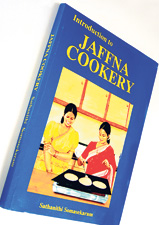
When she left Jaffna on her husband’s arm as an 18-year-old, Sathanithi Somasekaram took with her the secrets of her mother’s kitchen – she carried the recipes of curry powder and kool, the bruised pink of the Rasavalli pudding, and the delicacy of the milk rotti in her head.
When she finally put them to paper, her book “Jaffna Cookery” became one of the few compilations of authentic Jaffna recipes, and a compendium of the tastes of her childhood. Coconut and palmyrah make many an appearance, but so do drumsticks and eggplant.
Ejaz AhamedSathanithi Somasekaram: Putting together the secrets of her mother’s kitchen
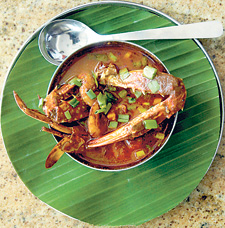
Jaffna cuisine is above all famous for its use of the fresh seafood that abounds along those coasts. The soup known as Kool is among the region’s signature dishes. “Everyone likes it,” says Mrs. Somasekaram, explaining that the dish is a meal in itself. Its unique flavour results from a slew of mouth watering ingredients. Crab, fish, cuttlefish, prawns and crayfish create a seafood broth into which Mrs. Somasekaram adds long beans, jak seeds, manioc and spinach. With hints of tamarind, the entire dish is thickened with the help of palmyrah root flour.
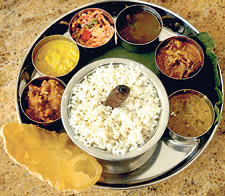
Mrs. Somasekaram’s book includes pictures of some signature dishes. In a layout for lunch, red rice accompanies a set of curries that appear to conform to the standard rice and curry menu that is so common across the island. A closer inspection however, provides something of a surprise.
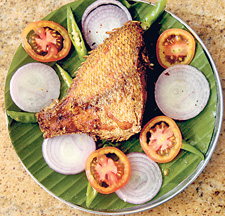
The clear liquid is bone rasam. Made with mutton bones, the light, peppery broth is superb with rice and fried fish and is often drunk plain to clear the nose and the sinuses. Explaining that she, like most Jaffna cooks prefers to use boneless chicken, Mrs. Somasekaram says she uses the bones to make a spicy chicken rasam as well. Consistency occasionally decides the category to which a dish belongs – a curry is typically thicker than a kulambu, and a kulambu is thicker than a sodhi.
Other dishes have their own story. She is particularly fond of the white, round eggplants that grow in certain parts of Jaffna. “These are good for white curries and we use green chillies instead of red chillies to make it very hot,” she says. Her table also holds a fairly straightforward dhall curry, a tart tomato kulambu and a vallarai sambal which is essentially her take on a gotukola sambal.
While her book includes recipes for eggplant and ash plantain sambols, the more adventurous gourmands might be drawn to the range of dishes known as varai. In these finely chopped or minced ingredients are tossed with coconut, green chillies, mustard seeds, red onions, turmeric powder and curry leaves to create a distinctive dish.
A good varai is light and flavourful, with each ingredient providing a distinct flavour. Though finely minced the primary meat or vegetable remains firm on the tongue and is never reduced to mush. Shark meat varai uses the tough, distinctive meat in a dry mix, but you can also use prawns, drumsticks, leeks, drumstick leaves and even plantain flowers to create the same dish.
Mrs. Somasekaram finds room for several drumstick-based recipes in her book, in part because she remembers them being a staple food in her childhood. “Every home would make murunga (drumstick) curry in different forms – one day with prawns, one day in a sambhar, one day in curry, one day in varai...” she says reminiscing.
For her the dry stalks that are up for purchase in Colombo are but pale imitations of those at home. Explaining that most families grow them in their backyards, she says “Jaffna murunga are fleshy and long, here it is like a stick...very hard.”
Her recipes are enhanced by conversation with her, placing them in their rich socio-cultural context. For instance, among her desserts is the dish known as kolukattai – when a groom’s family goes to meet the bride’s side for the first time, the dish is taken along to serve as a sweet, beginning a new relationship. Of the two recipes for curry powder that she provides in her book, one is without chillies.
It is said to be best suited for invalids and to nursing mothers – the mix is said to stimulate the flow of nourishing milk.
Pulich Canji or sour porridge is good for those burdened with a cough or cold. Her subtly flavoured tamarind rice, a favourite with her family, has its own tale. As a young girl, Mrs. Somasekaram recalls making the annual pilgrimage to Nagadipa with her family – their menu for the trip rarely changed. Tamarind rice, known as Puli Chaadham, and ginger pachadi and brinjal fried in gingili oil were always taken around, because all three would survive the long trip, unrefrigerated.
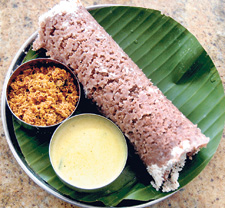
The fried brinjal is a favourite with Jaffna schoolchildren who take it to school with another signature dish – pittu. The dryness of this combination is rarely to the liking of the adults who prefer their pittu with curry or perhaps laced with fish as in shark pittu. Traditionally made with rice flour and scraped coconut, the dish is steamed so that the small flakes and nodules of the rice flour separate. A variation on the recipe produces a sweeter milk pittu.
Soon, Mrs. Somasekaram and her family will celebrate the Tamil New Year, giving thanks to the sun for a good harvest with jaggery pongal – a sweet rice dish often eaten with the fat, sturdy kolikuttu plantain. Should you wish to sample a sweet mouthful yourself in a city where very few places serve authentic Jaffna food, cooking at home might be your best option. Priced at 499/- and published by Vijitha Yapa, Jaffna Cookery is available at all leading bookstores.
Jaffna fast food
Ejaz Ahamed is in the process of constructing a chain of restaurants that serve Jaffna cuisine. He intends to offer an option to more pricey venues like Hotel Renuka’s Palmyrah with his own Yaal.
Located on Colombo’s Marine Drive, the restaurant features almost spartan interiors and an ocean view. Your food is served up by chefs from the region and at very modest prices. “There’s a demand,” says the hotelier, explaining that Yaal will soon be a chain, with a new outlet in Pettah.
Among his five chefs are men with considerable experience, says Mr. Ahamad, proud of his distinctive menu that includes favourites like Jaffna style crab curry (Rs.200), kanawa (cuttlefish) curry (Rs.180) and Thirukkal Pittu (Rs.150) made with flying fish found in Jaffna. Also on offer is idiyappam and sodhi (5 for Rs.40) but its popularity pales in comparison to Odiyal Kool (Rs.200) the restaurant’s most famous offering.
The Kool takes several hours to prepare properly, says Mr. Ahamad, adding that this, along with delicacies like mutton soup (Rs.250) and Suraa Pittu (Rs.240) made with sharkmeat are delicacies reserved for the weekend.
Yaal is a family business, run by the same group that have made successes of hotels like Marrybrown, Olive’s Kitchen and Grill, Indian Spice and Mb Chennai, and Mr. Ahamad is confident that his customers will arrive in droves to sample dishes like chicken/fish perattal and idiyappam biriyani, that are above all “very spicy and tasty”. Contact 7548880 / 881.
Recipe for Jaffna Kool 
Ingredients: 
  • 150g fish
  • 150g cuttlefish
  • 150g prawns
  • 150g crabs
  • 150g crayfish
  • 100g long beans
  • 100g tapioca
  • 100g jak seeds
  • 100g spinach
  • 3tbsp rice
  • ¼ cup Palmyrah root flour*
  • 10 dry chillies (powdered)
  • 1 ball tamarind (lime size)
  • ½ tsp turmeric powder
  • 2 bottles water
  • Salt to taste
Preparation:
  1. Clean and wash the fish and the cuttlefish. Cut the cuttlefish into 3 cm pieces and the fish into larger pieces.
  2. Shell the prawns
  3. Wash and quarter the crabs
  4. Clean the cray fish and cut into chunky pieces
  5. Break the beans into 3 cm pieces
  6. Peel and dice the tapioca
  7. Wash and chop the spinach
  8. Cut the jak seeds into halves and then peel off the skin
  9. Soak the flour in a pint of water for ten minutes and then strain the water off. 
  10. Dissolve the tamarind in a pint of water for ten minutes and then strain and retain the water. 
Method: 
  1. Half fill a large pan with water and bring to boil. 
  2. Add the fish, cuttle fish, prawns, crayfish, crabs, rice, beans, tapioca, jak seeds and salt and cook for about 45 minutes until everything is soaked. Mix in spinach at this stage. 
  3. In a separate bowl mix the palmyrah root flower, tamarind solution, chilli powder and turmeric into a thick paste. 
  4. Add this paste to the seafood broth, mix well and simmer until it thickens. Remove from the fire as soon as preferred consistency is reached. 
  5. Can be purchased at the Palmyrah Board’s outlet ‘Katpaham’ at 244, Galle Road, Colombo 4.